
resources
California's 2028 Smart City Vision: What to Expect from the Leading Cities
08 Apr 2026

California is poised to unveil its ambitious 2028 Smart City plan, an initiative that extends far beyond the realm of high-tech gadgets and futuristic architecture. These transformative changes are slated for implementation across the state’s urban landscape, not solely within the sprawling metropolis of Los Angeles. At its core, the vision is to significantly enhance daily life—making it easier, safer, and notably greener for all residents. By integrating cutting-edge technology, innovating transit solutions, and prioritizing equitable access, these pioneering cities aspire to become global exemplars. Let's delve into the specifics of what's on the horizon and what you can anticipate.
Key Takeaways
- Artificial intelligence is poised to streamline traffic flow and public transportation, ensuring smoother commutes and substantially reducing congestion.
- Urban services, including public safety and emergency response, will see enhanced connectivity, facilitating quicker, more targeted assistance where it’s most needed.
- Intelligent technologies will optimize energy, water, and waste management systems, leading to significant resource conservation and a notable reduction in pollution.
- Robust high-speed internet and extensive sensor networks will furnish urban planners with invaluable real-time insights, empowering them to address challenges and strategically plan for the future.
- Crucially, the initiative emphasizes equitable access to digital infrastructure and emerging technologies, ensuring that benefits are inclusive and not limited by socioeconomic status or technical proficiency.
Transforming Urban Mobility for Seamless Travel
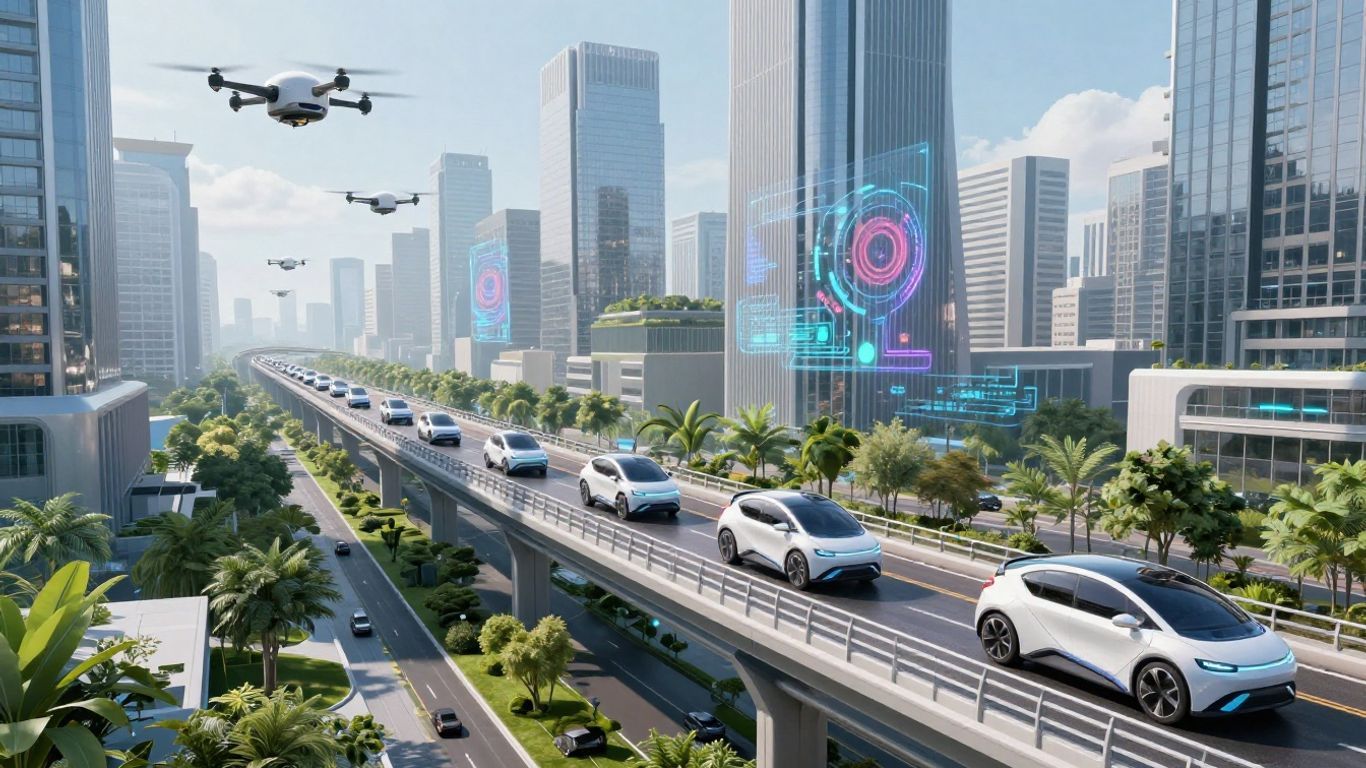
California's 2028 smart city vision is fundamentally about revolutionizing how people and goods traverse urban environments. It’s no longer simply about getting from point A to point B; rather, it’s about cultivating a connected, highly efficient, and environmentally cleaner paradigm for travel across the state’s principal cities.
AI-Managed Traffic and Public Transport
Can you imagine traffic lights that intuitively communicate with each other—and even with your vehicle—dynamically adjusting their timing in real time to ensure traffic flows smoothly? This intelligent coordination is precisely the concept underpinning AI-managed traffic systems. These sophisticated networks meticulously observe traffic patterns, proactively predict potential congestion points, and adeptly guide vehicles around them. Public transportation is likewise receiving a significant boost. AI will intelligently fine-tune bus and train schedules based on immediate rider demand, dramatically cutting down on wait times and, consequently, making public transit a far more appealing option. The ultimate objective is a substantial reduction in the number of personal vehicles on the road, leading to a much less stressful commute for everyone.
Seamless Multi-Modal Transit Systems
Navigating a bustling city often necessitates switching between various modes of transport—perhaps a bus, followed by a train, and then an electric scooter for that final stretch. The 2028 plan aims to render these transitions utterly effortless. Picture a single, intuitive application or a unified payment system that manages your entire journey, from booking a ride-share to purchasing a train ticket and unlocking an electric bicycle. This integrated approach, often termed multi-modal transit, not only simplifies travel planning but also actively encourages individuals to utilize a diverse mix of transport options, thereby lessening reliance on single-occupancy vehicles.
The Rise of Autonomous Vehicles
Autonomous vehicles, commonly known as self-driving cars, are an integral component of this future landscape. While still undergoing development and refinement, they hold immense promise for reducing accidents and significantly enhancing transport accessibility for individuals unable to drive themselves. Successfully integrating these vehicles—safely and efficiently—into the existing transit mosaic will be paramount. Indeed, they could serve as vital connectors, seamlessly transporting individuals from train stations or bus stops directly to their final destinations. The formidable challenge, however, will be ensuring their harmonious operation alongside other transport methods, all while avoiding any exacerbation of traffic issues.
The future of urban navigation isn't about choosing just one mode of transport; it's about meticulously constructing a cohesive system where diverse options work in concert. This means buses, trains, ride-shares, and even micro-mobility solutions like bikes all playing a pivotal role within a truly connected network.
Here's a glimpse into how different transport modes are expected to collaborate:
- AI-Optimized Public Transit: Public transit, dynamically optimized by AI, will see schedules adjusting in real-time according to passenger demand.
- Integrated Payment & Booking: An integrated payment and booking system will offer a unified platform for planning and purchasing multi-modal journeys.
- Autonomous Vehicle Integration: Autonomous vehicles are slated for integration, serving as efficient first- and last-mile connectors.
- Enhanced Intercity Buses: Enhanced intercity bus services will provide comfortable, reliable connections between urban centers, seamlessly integrating with local transit hubs.
| Feature | Current State | 2028 Vision |
|---|---|---|
| Traffic Management | Reactive, signal-based | Proactive, AI-driven, real-time adjustments |
| Public Transit Scheduling | Fixed schedules | Dynamic, demand-responsive |
| Journey Planning | Separate apps/systems for each mode | Unified platform for multi-modal trips |
| Vehicle Ownership | High reliance on personal cars | Shift towards shared and public transport options |
| Autonomous Vehicle Role | Limited pilot programs | Integrated as connectors and for accessibility |
Enhancing City Safety and Essential Services
California's 2028 vision for its cities truly extends beyond mere operational efficiency; it is, in essence, about cultivating urban environments that are inherently safer and more responsive for every resident. Consider the traditional experience of interacting with city services. One might navigate a labyrinth of departmental calls for various issues, often feeling as though concerns vanish into an administrative void. The smart city approach endeavors to fundamentally alter this dynamic by thoroughly interconnecting every facet of municipal management.
Proactive Technology for Public Safety
Envision a city where potential hazards are identified and addressed long before they escalate into significant crises. This concept, far from being a distant fantasy, is rapidly becoming a tangible reality. New technologies are continuously being innovated to bolster community safety. Sensors strategically positioned throughout the urban fabric can diligently monitor crucial parameters such as air quality, traffic flow, and even detect anomalous activities. Artificial intelligence systems then meticulously analyze this incoming stream of sensor data. This capability translates directly into swifter responses to potential emergencies—be it a burgeoning fire, a vehicular accident, or any other unforeseen incident. For instance, interconnected systems could instantly register an abrupt increase in smoke detection and, without human intervention, immediately alert the fire department—perhaps even before any human witness perceives it. This forward-thinking, proactive methodology is absolutely critical to preventing problems from metastasizing into major calamities.
Unified Digital Platforms for Urban Services
One of the most persistent frustrations for city dwellers often revolves around the complexity of engaging with various municipal services. Need to report a pesky pothole? Wish to schedule a bulky waste collection? Or perhaps you simply require information about local recreational facilities? Currently, these tasks frequently involve navigating disparate websites or enduring lengthy phone queues. The smart city plan aims to rectify this by consolidating access points into singular, intuitive digital platforms. Think of it as a super-powered evolution of existing city help systems, serving as one streamlined point of contact for residents. These advanced platforms are meticulously designed to simplify the acquisition of information and the request for services. They will be engineered for exceptional user-friendliness and availability in multiple languages, respectfully accommodating the diverse communities they are meant to serve. The overarching objective is to demystify interactions with city hall and ensure every individual can readily access the support they require, without unnecessary hurdles.
Advanced Emergency Response Mechanisms
When emergencies inevitably arise, the speed and efficacy with which a city can respond can make an profound difference. The 2028 vision incorporates the development of smarter infrastructure specifically engineered to bolster emergency services. This entails leveraging data analytics to precisely pinpoint where assistance will be most critically needed. For example, AI could analyze event schedules and prevailing traffic patterns to anticipate areas where ambulances or police units might be required. Furthermore, traffic signals could be automatically reconfigured to grant emergency vehicles an unobstructed path. Even buildings and roadways can be outfitted with sensors that provide real-time situational updates, enabling emergency crews to rapidly comprehend on-the-ground conditions. This profound level of interconnectedness is indeed vital for fostering a city that is not only more resilient but also significantly better prepared.
The principal goal is to transition from merely reacting to problems post-occurrence to establishing a sophisticated system where technology actively aids in problem prevention and dramatically accelerates responses when emergencies are unavoidable. Ultimately, this approach should lead to a far more efficient allocation of resources and, in turn, a safer environment for every resident.
Here's a look at the types of data that might be monitored:
- Environmental conditions: Environmental conditions, such as air quality, ambient noise levels, and temperature fluctuations, will be under constant scrutiny.
- Traffic flow: Traffic flow will be meticulously tracked, encompassing vehicle and pedestrian movements, alongside average speeds.
- Infrastructure status: The status of critical infrastructure will be monitored, including energy consumption, water pressure, and component integrity.
- Public safety indicators: Public safety indicators will leverage motion detection and the identification of unusual activities.
This relentless stream of real-time information provides an exceptionally granular and current picture of how the city is operating.
Pioneering Sustainable Urban Living
California's 2028 vision is, at its heart, about cultivating superior urban living environments, and a significant facet of this ambition involves our stewardship of the environment. Consider how we consume energy, manage our cherished green spaces, and distribute water to our populace—each of these critical systems is undergoing a shrewd, eco-conscious transformation.
Renewable Energy Grids and Smart Management
Cities are undeniably prodigious consumers of power, and the 2028 plan aims to revolutionize this by dramatically increasing reliance on clean energy sources like solar and wind. These aren't just passive systems; rather, they'll be dynamically managed through data-driven insights. Can you imagine a power grid capable of predicting peak electricity demand and automatically adjusting supply, perhaps storing surplus solar power harvested during the day for deployment at night? This intelligent management significantly curtails waste and, crucially, enhances the overall reliability of the entire system.
- Predictive energy balancing: Predictive energy balancing will employ smart technologies to forecast energy demands and dynamically adjust supply.
- Connecting local power: The integration of local power sources—such as rooftop solar installations and home battery storage—into the main grid.
- Demand-response programs: Incentivized demand-response programs will encourage reduced power consumption during peak periods.
Intelligent Water Networks
Water, that most precious resource, is a key focus of the 2028 vision, which includes more intelligent methods for its management. This means deploying an array of sensors throughout the water system to detect leaks instantaneously. It also involves meticulously managing water pressure with far greater precision. The overriding goal is to substantially reduce water loss and ensure that this vital resource is never squandered.
The overarching aim is to forge cities that coexist harmoniously with nature, rather than contending against it, by employing technology to fortify and optimize natural systems.
Smart Waste Management
The often-overlooked area of waste management is also slated for a technological upgrade. The plan incorporates the strategic placement of sensors within waste bins. These sensors will autonomously detect when a bin is full and, critically, communicate this information directly to collection services. This proactive system means collection trucks will avoid making unnecessary trips—thereby conserving fuel, reducing operational costs, and diminishing pollution. It's a deceptively simple concept that promises a significant improvement in the efficiency of our waste management practices.
Building the Digital Backbone of a Connected City
Imagine an urban environment where information flows as effortlessly as traffic, and technology functions akin to an invisible nervous system. This grand vision defines California's 2028 smart city initiative, a future meticulously constructed upon a robust digital foundation. This endeavor transcends mere high-speed internet; it is about forging an intricate, connected network that profoundly improves urban life, from your everyday commute to the city's critical emergency response capabilities.
High-Speed Transit and Connectivity
At the very core of this interconnected urban fabric lies an unwavering commitment to ubiquitous, super-fast internet. Consider it the principal superhighway for data. This translates into reliable, lightning-quick internet access pervading every corner—within homes, businesses, along transit routes, and throughout public spaces. This foundational infrastructure is indispensable for all smart city projects, enabling devices, complex systems, and individuals to communicate instantaneously and seamlessly.
Sensor-Laden Environments for Data Collection
To truly comprehend and effectively govern a dynamic metropolis, we require "eyes and ears" at every turn. This is precisely where an extensive network of sensors becomes invaluable. Thousands of these devices, strategically embedded in traffic lights, lampposts, waste receptacles, and public transport vehicles, will continuously gather essential information. This invaluable data encompasses a broad spectrum:
- Environmental conditions: Monitoring air quality, ambient noise levels, and temperature.
- Traffic flow: Tracking both vehicular and pedestrian movements.
- Infrastructure status: Observing energy consumption, water pressure, and the structural integrity of various components.
- Public safety: Identifying and detecting unusual activities.
This relentless stream of real-time information provides an exceptionally granular and current picture of how the city is operating.
All the data meticulously gathered by sensors and interconnected systems necessitates sophisticated analysis. This is precisely where the power of big data and artificial intelligence truly comes into play. Specialized platforms will meticulously process this vast information to discern patterns, forecast future needs, and optimize urban operations. Ultimately, it’s about leveraging data to make acutely informed decisions.
The Digital Infrastructure Core
This entire sophisticated system fundamentally relies on a robust digital core—the intricate network that intricately links every component. This critical infrastructure includes:
- Fiber optic networks: The physical backbone enabling ultra-high-speed data transfer.
- Wireless communication: Encompassing pervasive Wi-Fi and next-generation 5G/6G networks.
- Data centers: Secure, state-of-the-art facilities dedicated to storing and processing the immense volumes of collected information.
This foundational core infrastructure facilitates the real-time data exchange indispensable for smart city functions to operate with both efficacy and unwavering reliability.
Evolving Wealth Creation and Economic Models
California's 2028 smart city vision isn't merely focused on enhancing operational smoothness; it also fundamentally rethinks how cities generate revenue and strategically engage with the global economy. Consider urban hubs like Los Angeles as expansive laboratories for pioneering economic paradigms. The core objective is to innovate novel approaches to wealth creation and sustainable growth—models that other cities will be keen to replicate. This necessitates a proactive exploration of emerging industries, perhaps even delving into fields like space technology or advanced biotechnologies, all designed to attract leading talent and substantial investment from across the globe.
Cultivating New Industries and Attracting Talent
This particular facet centers on nurturing nascent industries—those just emerging or even yet to be fully defined. Furthermore, it involves actively drawing in the brightest minds and significant capital from around the world. The underlying premise is to transform cities into dynamic hubs that not only accommodate populations but actively drive widespread prosperity for many.
Developing Exportable Smart City Solutions
Innovations forged within California's smart cities are not intended to remain confined within their borders. The strategy involves creating solutions that are readily shareable or marketable to other municipalities. This could manifest as a groundbreaking method for traffic management, a superior energy system, or a more intuitive digital platform for urban services. Such an approach not only cultivates new business opportunities but also actively contributes to building a global network of interconnected, intelligent cities. It is, in essence, about disseminating the blueprints for a smarter future, firmly positioning California as a vanguard in urban development.
Technology-Driven Infrastructure Efficiency
A city that operates with optimal efficiency inherently saves both time and resources. California's plan leverages smart technology to enhance the performance of virtually every urban system, from how its citizens navigate to how energy is consumed. It transcends mere high-tech gadgets; rather, it’s about ensuring resources are utilized judiciously, minimizing waste. For example, intelligent power grids can manage electricity distribution with greater precision, and AI can optimize delivery routes for enhanced efficiency. This unwavering focus on efficiency promises considerable financial savings and tangible environmental benefits.
Here's a quick look at how technology can improve things:
| Area of Improvement | Technology Used | Expected Outcome |
|---|---|---|
| Energy Management | Smart Grids, AI | Less waste, lower costs |
| Transportation | AI Traffic Control, IoT | Smoother flow, less traffic |
| Resource Distribution | Predictive Analytics | Better deliveries, less spoilage |
The core idea is to establish cities as engines of innovation, capable of generating widespread prosperity. This entails developing novel economic models that are sufficiently effective and compelling for other cities globally to emulate.
Ensuring Equity and Inclusivity in the Smart City
California's vision for 2028 isn't solely about implementing gleaming new technologies; it’s profoundly about ensuring universal access and benefit for everyone. The fundamental objective is to construct an urban environment that truly serves all its residents, irrespective of their background, income level, or geographic location. This commitment mandates proactive efforts to bridge existing disparities and guarantee that emerging technologies leave no one behind.
Addressing the Digital Divide
The digital divide is, regrettably, a tangible reality. It represents the disparity between individuals who possess access to modern information and communication technology and those who do not. In a smart city context, this gap could delineate the difference between seamlessly accessing vital urban services online and struggling to obtain even basic information. California intends to confront this challenge head-on by meticulously ensuring that the advantages of smart city technology are broadly distributed.
- Ensuring universal usability of services: This involves crafting intuitive applications and websites, accessible even to individuals less familiar with technology.
- Accommodating diverse needs: For instance, public transit applications may require multi-language support or features designed for senior accessibility.
- Problem-centric development: Technology will be developed to address genuine community needs, rather than solely pursuing novelty.
The fundamental aim is to create technology that genuinely empowers people, rather than expecting individuals to adapt their lives to fit the technology. This vital approach necessitates open dialogue with communities and a deep understanding of their authentic requirements—a truly human-centered design philosophy.
Expanding Broadband Access
High-speed internet forms the indispensable backbone of any truly smart city. Without it, many of the envisioned services would simply be inoperable. California is unequivocally committed to ensuring that high-quality internet is available across all areas, extending far beyond affluent neighborhoods. This commitment involves several key strategies:
- Investing in robust infrastructure: Expanding fiber optic networks and enhancing wireless coverage, particularly in underserved regions.
- Strategic partnerships with providers: Collaborating with internet service providers to ensure the availability of affordable plans.
- Exploring public and community-based solutions: Investigating city-managed or communal internet services to bridge connectivity gaps.
Digital Literacy Training and Affordable Devices
While access to the internet and smart devices is certainly a critical component, it represents only part of the solution. Individuals must also possess the requisite skills to utilize these tools effectively and affordably. California is actively exploring comprehensive programs to assist residents in developing these essential digital proficiencies.
- Comprehensive training programs: Providing workshops and courses focused on leveraging computers, smartphones, and online services effectively.
- Ensuring device access: Implementing initiatives to supply low-cost or refurbished devices to households and individuals facing financial constraints.
- Establishing accessible support hotlines: Developing dedicated help desks for individuals encountering technological difficulties.
The ultimate goal is a truly connected city where everyone has the tangible opportunity to participate fully and thrive.
Looking Ahead: California's Smart City Future
As California steadfastly gears up for 2028, it’s abundantly clear that the state is aspiring to achieve far more than a mere technological upgrade for its urban centers. It’s fundamentally about constructing a future where daily life is smoother, demonstrably safer, and notably kinder to our planet. From traffic systems that actually flow with intelligent precision to energy networks that operate with optimal efficiency, the overarching objective is to forge urban environments that function superiorly for every single resident. These aren't abstract theoretical constructs; rather, they are concrete, actionable plans designed to enhance city livability and, crucially, to share successful methodologies with the wider world. It’s an exceptionally ambitious undertaking, to be sure, but one that holds immense promise for reimagining what cities can truly become.
Frequently Asked Questions
What exactly is the driving force behind California's 2028 Smart City plan?
Essentially, California is committed to transforming its urban centers, with a particular focus on Los Angeles, into highly intelligent and interconnected environments. Can you imagine an urban landscape that operates with unparalleled smoothness, enhanced safety, and greater ecological responsibility—all powered by innovative technology? That's the core idea: to give cities a high-tech overhaul to significantly improve life for everyone. Indeed, the aspiration is for these initiatives to serve as a global blueprint, inspiring other cities worldwide to emulate California's pioneering approach to urban intelligence.
How will this plan change the way people travel around?
Getting around is poised to become substantially more efficient! Picture traffic lights that communicate with one another, dynamically adjusting to keep vehicles moving seamlessly. Public transportation, including buses and trains, will operate with greater punctuality and responsiveness. You might even observe autonomous, self-driving cars becoming a more common sight. The overarching goal is to simplify transitions between various modes of travel—perhaps from a bus to a train—all managed through one intuitive, integrated system.
Will these smart cities be safer?
Yes, absolutely! The plan strategically employs technology to bolster community safety. Specialized sensors and cameras can aid in identifying potential issues, such as a nascent fire or unusual activity, often even before human intervention is required. This also translates into more sophisticated mechanisms for managing emergencies and ensuring that all residents can readily access essential urban services.
How will smart cities be more eco-friendly?
California's strategy is deeply committed to fostering greener urban environments. This includes transitioning towards greater reliance on clean energy sources, such as solar and wind power, and intelligently managing these systems to minimize waste. Water management networks will also become more intelligent, swiftly detecting and addressing leaks to conserve this vital resource. Even waste collection will be optimized for efficiency, with bins signaling when they're full—resulting in fewer unnecessary truck journeys and reduced emissions.
What is the 'digital backbone' of a smart city?
The digital backbone serves as the city's primary superhighway for information. It entails ensuring ubiquitous, super-fast internet access—in homes, businesses, and public spaces alike. A vast array of sensors will be strategically deployed throughout the city to continuously gather data on aspects like traffic patterns, air quality, and energy consumption. This invaluable information empowers city administrators to gain a clearer understanding of urban operations and make more informed decisions.
How will smart cities help everyone, not just tech-savvy people?
A significant emphasis of the plan is to ensure that everyone benefits from these new technologies. This means dedicated efforts to extend internet access to underserved areas and providing comprehensive training so individuals can confidently utilize computers and smartphones. The initiative also aims to assist residents in acquiring affordable digital devices. The fundamental objective is to guarantee that no one is marginalized or left behind in this evolving digital urban landscape.


